Suggestions
Review and act on what Aevy reads from your documents.
What a suggestion is
Section titled “What a suggestion is”Every asset carries a paper trail: inspection reports, grid connection agreements, O&M plans, specifications, record drawings. The facts you need (a transformer rating, an inspection deadline, a substation name, a change of owner) are in those documents, but reading each one and copying the facts into your asset register by hand is slow and easy to get wrong.
A suggestion is Aevy doing that reading for you. When a document arrives, Aevy reads it and proposes a specific change to your data: a component to add, a property to set, a date to record. Each proposal is one suggestion.
A suggestion is always a draft. Nothing in your asset register changes until you accept it. You stay in control of what gets written and what does not.
Where suggestions come from
Section titled “Where suggestions come from”Aevy generates suggestions from the documents already attached to your assets. Documents always arrive through the sync from your source, so none are added by hand: the moment a file lands there, it flows onto its asset and into this loop. The flow is the same every time:
- A document syncs onto an asset from your source.
- Aevy reads the document and pulls out the facts it can support with evidence.
- Each fact becomes a suggestion, grouped under the document it came from.
- The suggestion waits for you on the Suggestions screen until you accept or dismiss it.
What decides which documents get reviewed, and how each one is turned into suggestions, is a set of rules. For now, we set those rules up for you: they are not something you configure yourself yet, and you do not need to. Suggestions simply arrive on this screen for you to review.
Finding your suggestions
Section titled “Finding your suggestions”Open Suggestions from the left sidebar. The number next to it is how many are waiting for review.
The screen has two panes:
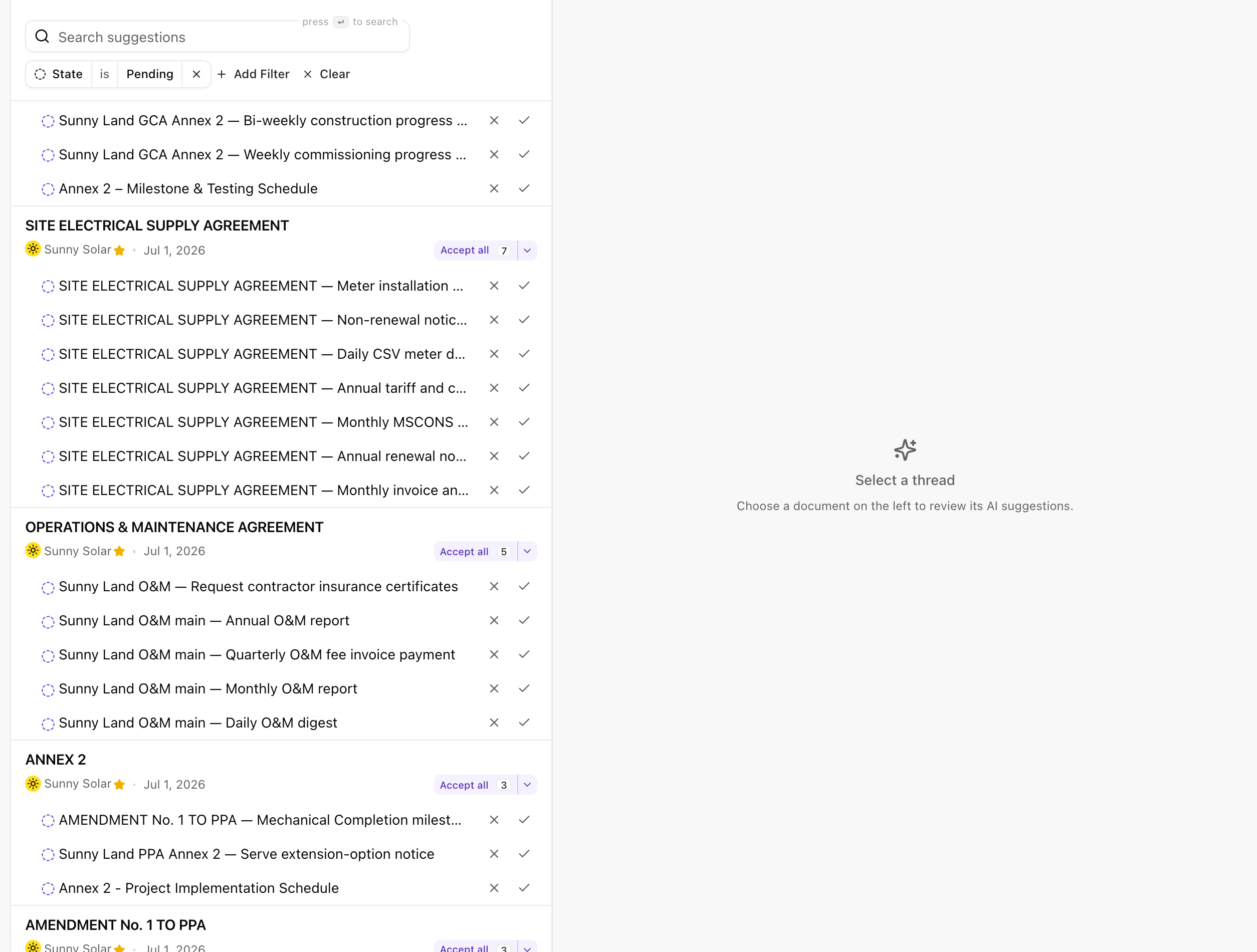
- Left: the review list. Every pending suggestion, grouped under the document it came from. Each group shows the document title, the asset it belongs to, and how many suggestions it holds.
- Right: the review pane. Select a document group on the left and its suggestions open here in full, with all the supporting detail.
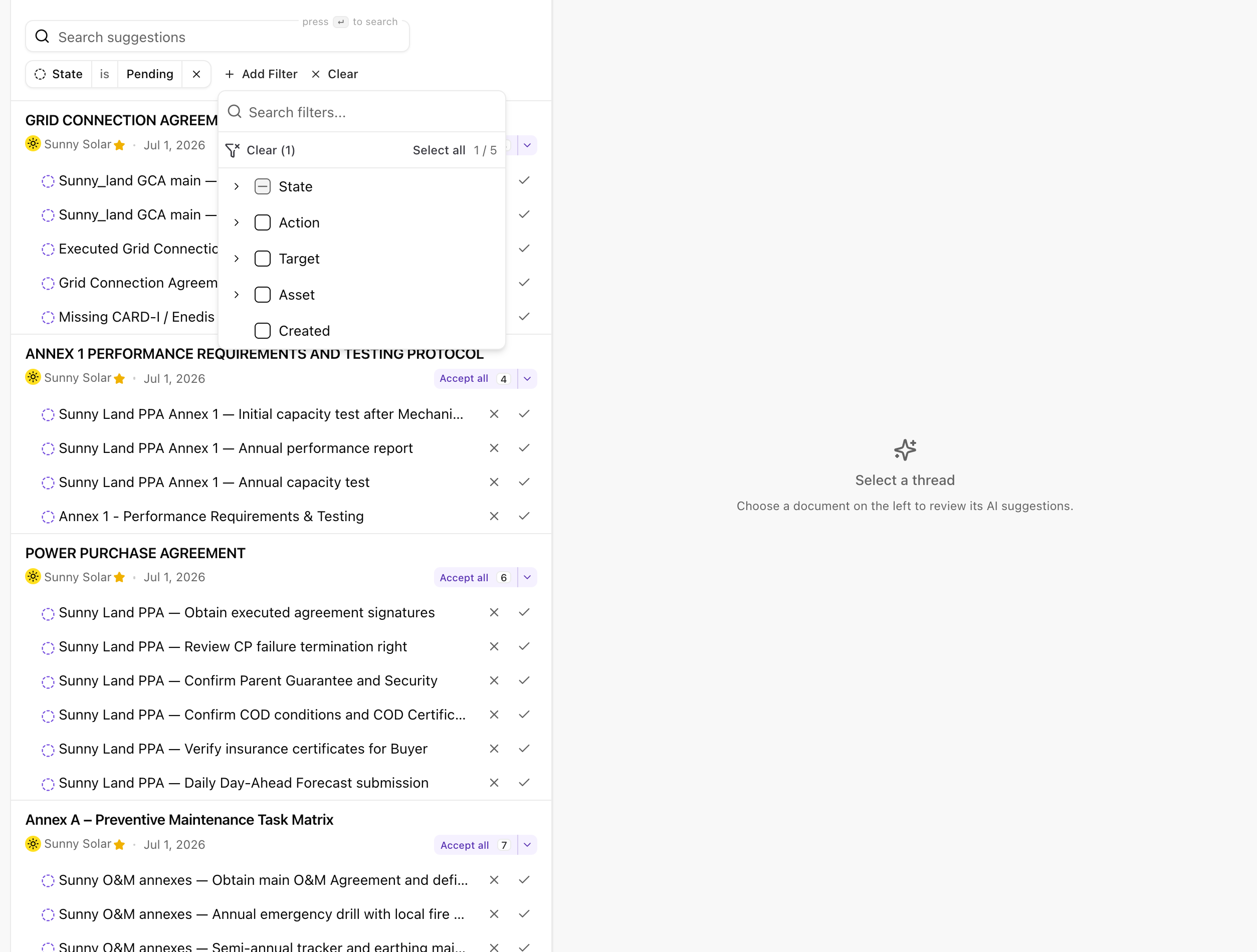
At the top, a search box and a filter bar help you narrow the list. By default the list is filtered to State is Pending, so you see only what still needs a decision. Use Add Filter to narrow further, or Clear to remove filters.
Anatomy of a suggestion
Section titled “Anatomy of a suggestion”Open a document group and its suggestions fill the review pane, one card each. Here the Sunny Solar operations and maintenance agreement holds five:
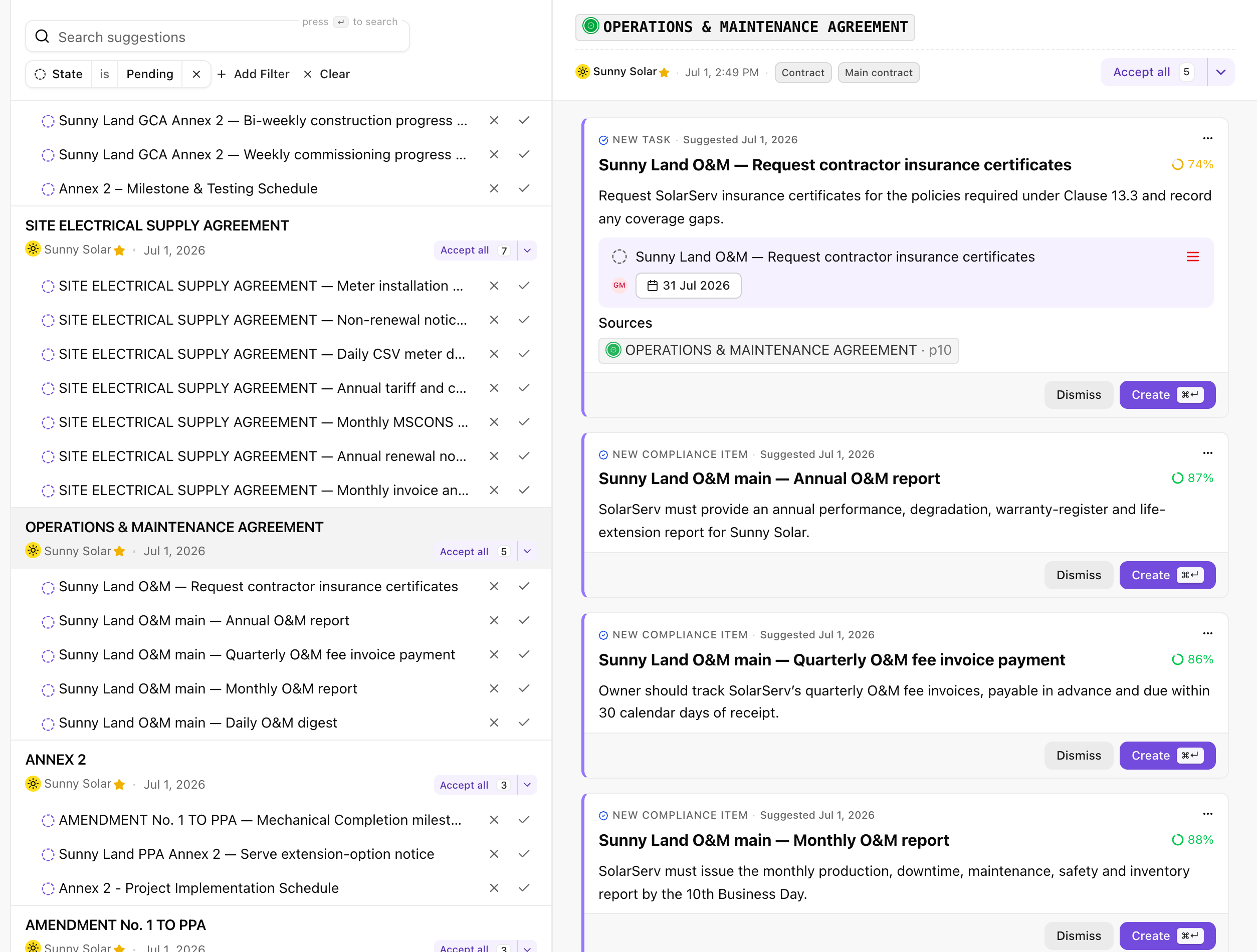
Every card is built to answer one question: can I trust this enough to accept it? Everything you need to decide is on the card.
 12345
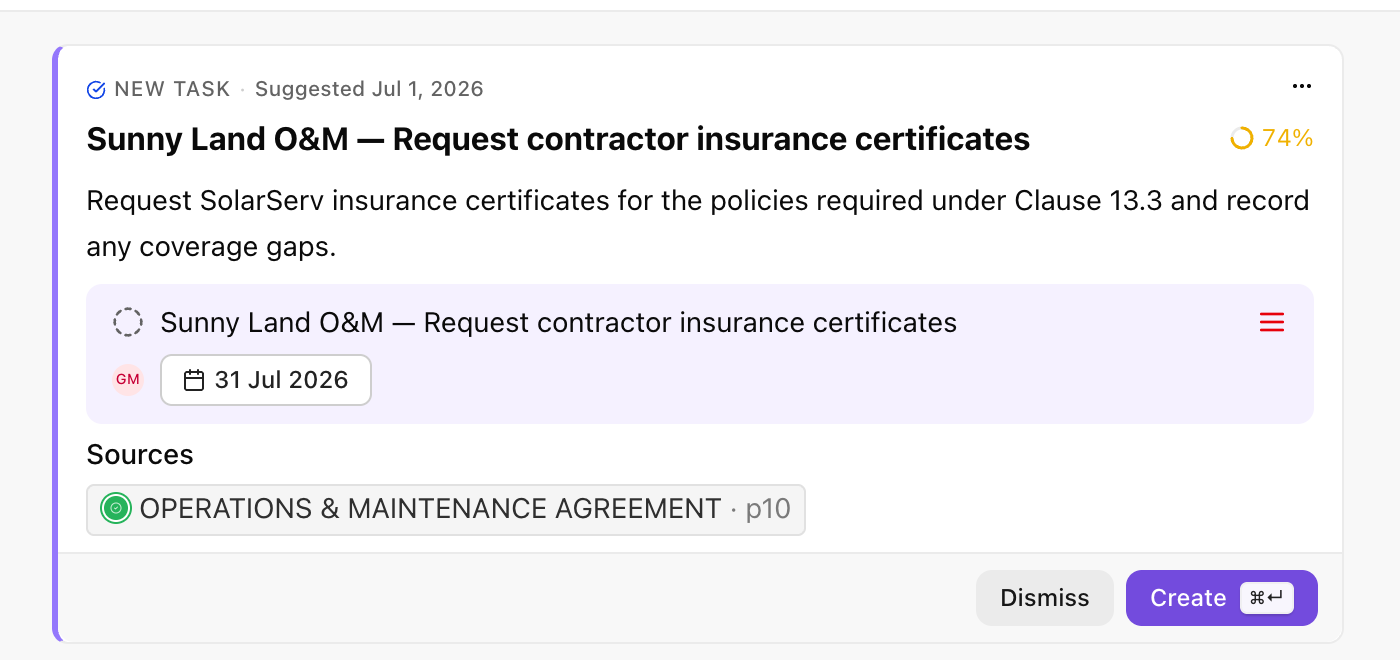
12345- Type. What Aevy proposes to create or change: a task, a compliance item, a component, an event, a property update. The badge names it.
- Confidence. How well the document supports the suggestion, shown as a percentage. More on reading this below.
- Description. The proposed change in plain language, with the clause or figure it rests on.
- Proposed record. A preview of exactly what will be created, with its fields (a due date, an owner, a value) laid out before you commit.
- Sources. The document the suggestion came from and the page it was found on, so you can open the original and check for yourself.
The named source and page are the point. You never take a suggestion on faith: every one traces back to the document and page that produced it, so you can confirm before you commit.
Reviewing suggestions
Section titled “Reviewing suggestions”You have three moves.
Accept
Section titled “Accept”Accepting a suggestion is the moment the change is written to your asset register. A new component appears on the asset, a property takes its new value, a date is recorded. Until you accept, none of that has happened.
In the review pane, you accept a suggestion with its Create button. In the list, each row has its own accept control, so you can act on a single item without opening it.
Dismiss
Section titled “Dismiss”Dismissing discards the suggestion. Nothing is written and the suggestion leaves your pending list. Use it when a suggestion is wrong, duplicated, or not worth recording.
In the review pane, this is the Dismiss button. In the list, each row carries its own dismiss control alongside accept.
Accept all
Section titled “Accept all”When a document is trustworthy and every suggestion under it looks right, Accept all applies the whole group in one action. The number on the button tells you how many suggestions you are accepting.
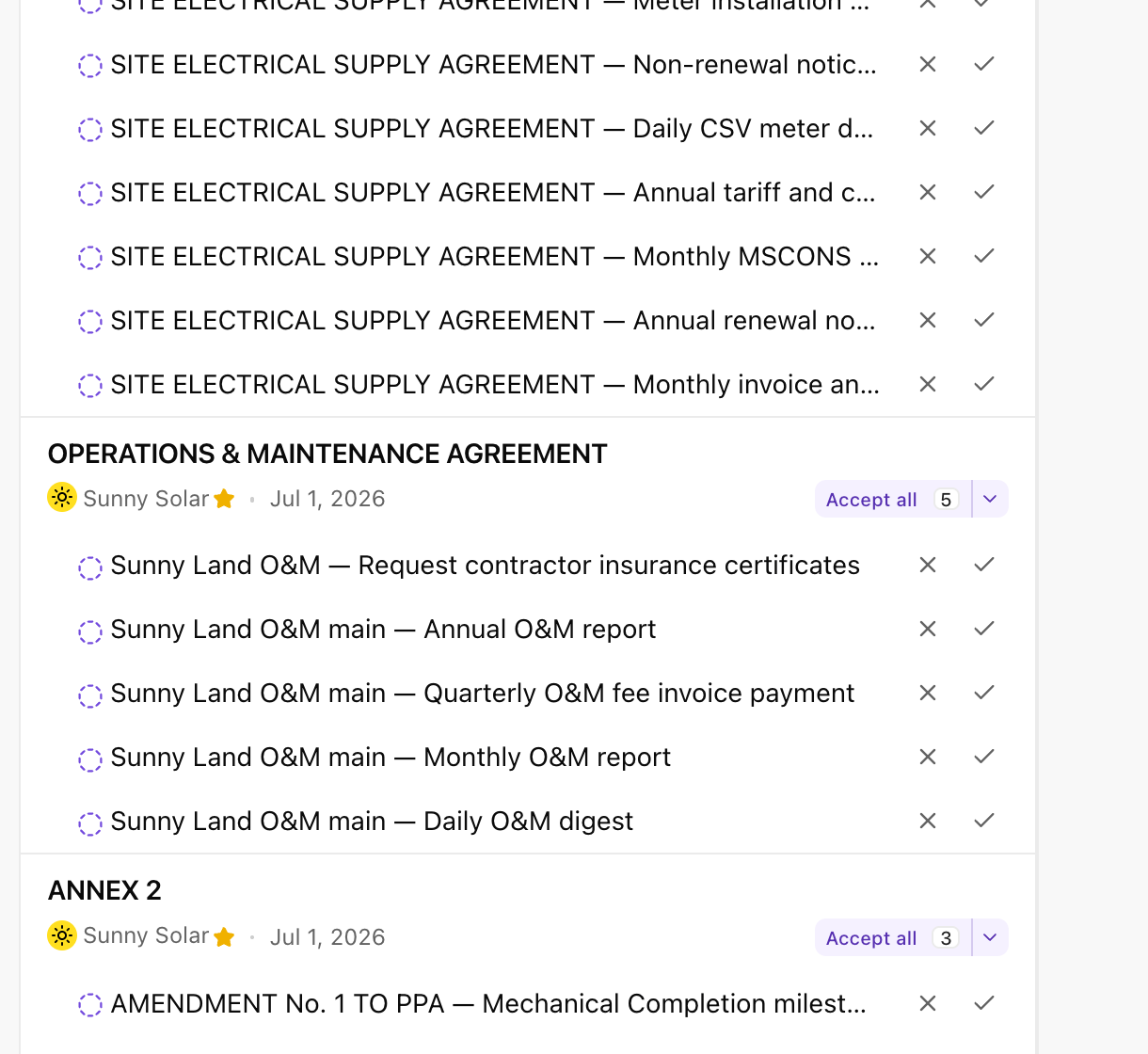
You are never forced into the batch: you can accept some items, dismiss others, and leave the rest for later. The list keeps whatever you have not yet decided.
What suggestions can change
Section titled “What suggestions can change”Aevy proposes whatever a document supports, across the record types you already work with:
- Tasks and reminders. An action a document calls for: request a certificate, serve a notice, review a clause before a deadline.
- Compliance items. An obligation to track: an annual report due, an invoice payable within set terms, a certificate to keep current.
- Components and systems. A transformer, a substation, a battery module the document describes but your register does not yet hold.
- Asset properties. A value on an existing asset: a connection voltage, an OEM, a capacity, an address.
- Dates and milestones. A commercial operation date, an inspection deadline, a delivery milestone drawn from an agreement or a report.
One document can yield several kinds at once: the agreement above proposes a new task and a set of compliance items, each with its own confidence and source.
Reading the confidence score
Section titled “Reading the confidence score”The percentage on each card is Aevy’s own estimate of how well the document supports the suggestion. As a rough guide:
| 90 to 100 percent | Stated directly in the document, close to word for word. |
| 70 to 89 percent | Strongly implied by the document, though not spelled out. |
| 50 to 69 percent | A reasonable inference, with some room for interpretation. |
| Below 50 percent | Speculative. Read the reasoning closely before accepting. |
The ring around the percentage fills and turns green as confidence rises, so a scan down the list tells you which suggestions are near-certain and which want a closer read before you accept.
Treat confidence as a prompt for attention: a high score still deserves a glance at the source, and a lower score is worth accepting when the description holds up and the evidence checks out. The score tells you where to look hardest, not what to decide.
Why it works this way
Section titled “Why it works this way”Two principles shape the whole feature.
Nothing changes without you. In asset management, wrong data has a real cost: a missed inspection deadline, a component that does not exist, a compliance record that is false. So Aevy never writes to your register on its own. Every suggestion is a draft, and accepting it is a deliberate step you take.
Every suggestion is auditable. Because each one names its source document and page, a suggestion is not a black box. You can always open what Aevy read and see why it proposed what it did, which is what lets you trust the ones you accept and confidently dismiss the ones you do not.
The result is a register you can stand behind: filled faster than by hand, but with a human decision behind every entry.