Documents
Find, read, and track every document on your assets, without filing anything by hand.
What the Documents page is
Section titled “What the Documents page is”Every document connected to your assets lands on the Documents page: inspection reports, contracts, drawings, operational reports. Documents arrive through a sync with your source: there is no upload step and nothing to file. The sync brings the folders too, not only the files. The structure you see is the structure at your source. When a document arrives we read it, pull out its key facts, and track where it is in processing, so you can find the right version without opening folders one by one.
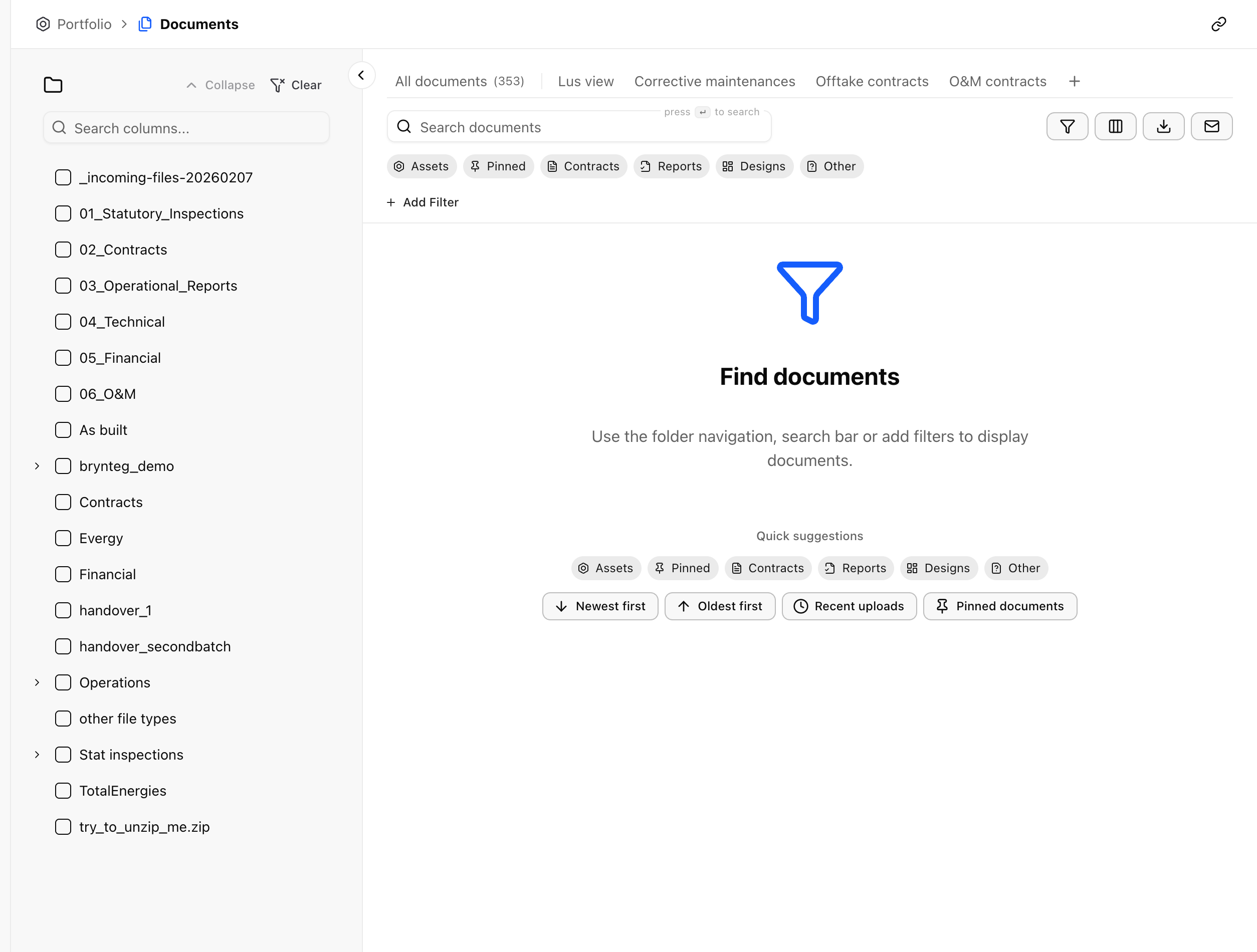
The page has two parts: a folder tree on the left, synced from your source, and a table on the right that lists documents once you narrow to what you want.
Finding a document
Section titled “Finding a document”Four tools narrow the list, and they combine:
- Folders. The tree on the left is your source structure, synced across: you browse the same folders you have at the source. You do not create or manage them here. Tick a folder to show only its documents.
- Search. Search documents matches on document names and briefs.
- Quick filters. The chips Assets, Pinned, Contracts, Reports, Designs, and Other jump to a common cut in one click.
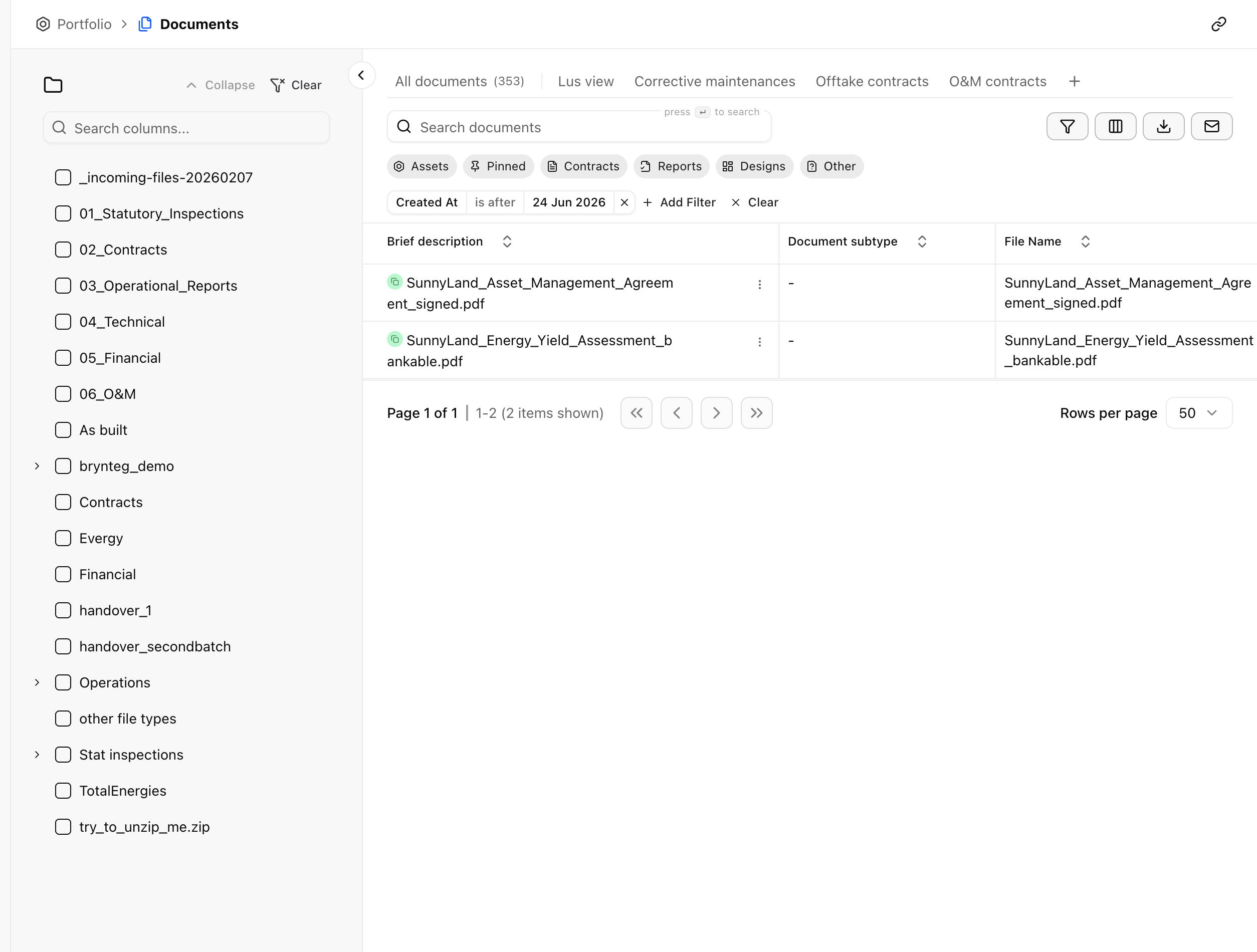
- Add Filter. For anything more specific, build a filter on any column. See the table filtering guide for how filters work.
Saved views sit along the top (All documents, and any views your team has saved). Each view remembers its own folders, filters, and columns, so a shared cut is one click away.
Reading a document
Section titled “Reading a document”Open a row to read the document in full. The original opens in the main pane, with a details panel beside it: the document type, the parties, the page count, and its signature state (signed, partially signed, or not signed). Tabs group the related work, any requirements the document touches, and other versions of the same document, so you can move from the file to what depends on it without leaving the page.
Document status
Section titled “Document status”Each document carries a status while we process it, so you know whether it is ready to trust. Most settle on Success. Along the way you may see OCR In Progress or Extraction Pending (we are still reading it), and occasionally a state that needs attention, such as Encrypted, Corrupt, or Document Too Long.
When a newer version of the same document arrives, the older one is marked Superseded and a duplicate is marked Duplicate, each with a link to the active version. You can still open the old one, but the status tells you it is not the one to work from.
Keeping a document close
Section titled “Keeping a document close”Pin the documents you return to often. A pinned document stays one click away under the Pinned filter and on its asset. See the favorites and pinning guide for how pinning works.